Evolutionary history is often presented as a succession of inventions, each permitting some new taxa to exceed the survival rates of their fellows. For example, fins first permitted swimming, then were adapted to sturdier limbs that enabled animals to walk on land. Jaws are often posited as transforming passive or weak feeders into highly efficient predators. Once a sufficiently useful evolutionary innovation appears we often infer this allows its owners to proceed toward ecological dominance.
But evolution rarely proceeds so neatly and certainly doesn’t do so in isolation. A new study by Wahei Hagiwara and Lauren Sallan at Okinawa Institute of Science and Technology Graduate University suggests that the rise of jawed vertebrates depended not on the invention of jaws per se, but on a catastrophe that dismantled the ecosystems around them. Their analysis places one of the decisive episodes in vertebrate history immediately after the Late Ordovician Mass Extinction (LOME), ~445–443 million years ago. This extinction event was the first of five well recognized mass extinctions to have occurred in the last ~550 million years.
A world before fishes ruled the seas
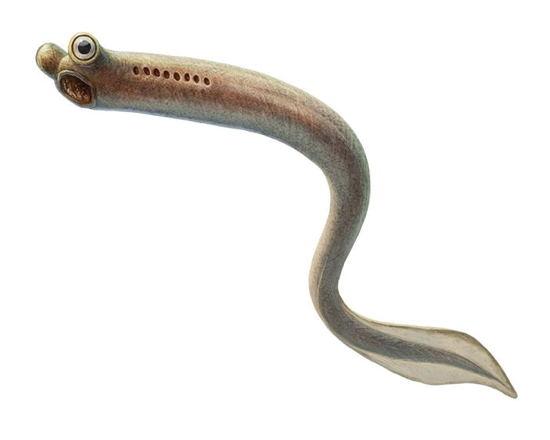
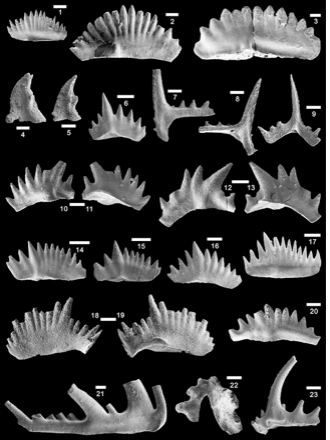
Today, nearly every vertebrate belongs to the jawed vertebrate lineage. The key living exception are the cyclostomes: our dear lampreys and hagfishes. The Ordovician seas looked very different to today and were dominated by benthic invertebrate groups. An extinct group of jawless vertebrates called conodonts were both widespread in a range of habitats and diverse in terms of their feeding apparatus. Conodonts are known almost exclusively from their abundant tooth-like feeding elements, although a handful of exceptionally well-preserved fossils reveal them to be small, elongate animals with broadly lamprey-like bodies. In the evolutionary framework used by Hagiwara and Sallan, conodonts represent early members of the broader cyclostome lineage.
Meanwhile, another collection of vertebrates was beginning to appear. This included the earliest jawed fishes as well as several jawless lineages more closely related to jawed vertebrates than to lampreys (arandaspids and astraspids). These animals were present during the Ordovician, but they remained uncommon and geographically restricted. Why then, if jaws and other recognizably modern vertebrate features had already begun to evolve during the Ordovician, did those animals that possessed them not immediately become dominant?
Mass extinction as an ecological reset button
To investigate this puzzle, Hagiwara and Sallan assembled fossil occurrence records spanning the Ordovician, as well as the following Silurian and Devonian periods. Their principal Ordovician–Silurian dataset included 449 species, organized into 169 fossil communities distributed among five major geographic regions. They then reconstructed changes in diversity, ecological composition, and geographic distribution before and after the extinction. The pattern they recovered was not a simple replacement of jawless animals by jawed ones.
The Late Ordovician extinction impacted conodonts severely, but it also disrupted the earliest communities of jawed vertebrates and other jawless relatives. The immediate aftermath was not an evolutionary explosion; global vertebrate diversity remained extremely low for approximately three to five million years. Recovery then occurred unevenly. Different lineages diversified within separate geographic refuges, producing strongly endemic communities. South China appears to have been particularly important for the early diversification of jawed vertebrates, whereas several mobile, lightly armored jawless groups (e.g., thelodonts) spread more rapidly between regions. Other heavily armored jawless lineages remained confined to the areas in which they originated.
Thus, the “Age of Fishes” (Devonian period) did not begin with a single victorious lineage sweeping across the planet. It began in the Silurian period as a collection of isolated evolutionary experiments. Only later, as shallow seas became better connected, did some of these regional lineages disperse more widely. Jaws may have offered important functional advantages in some places during some time periods, but possessing jaws was not enough in and of itself. Ecological opportunity, geographic isolation, environmental disruption, and simple historical contingency all helped determine which vertebrates eventually flourished.
Where do lampreys enter the story?
Modern lampreys (Petromyzontiformes) are not descendants of the armored jawless fishes that diversified after the extinction, and this study does not identify a fossil ancestor of living lampreys. Lamprey fossils are in fact quite rare and widely dispersed across evolutionary time. This challenges the persistent description of lampreys as “primitive” fishes or evolutionary relics. Lampreys today retain some characteristics that help researchers investigate early vertebrate evolution, but they are not frozen representatives of the Ordovician. The lamprey ancestors survived repeated environmental upheavals, extinctions, ecological reorganizations, and hundreds of millions of years of subsequent evolution.
Survival is not the same as stasis
The rarity of soft-bodied vertebrate fossils also imposes an important limitation on any reconstruction of evolutionary history. Conodont feeding elements, scales, spines, and armored plates of other jawless and early jawed vertebrates preserve far more readily than animals lacking mineralized tissues (as is the case with lampreys). Some apparent absences may, therefore, reflect preservation or sampling rather than biological absence. The identities of several early vertebrates are also inferred from isolated fragments whose evolutionary relationships remain uncertain. Hagiwara and Sallan address these problems in this study through alternative classifications and geographically explicit analyses, but the fossil record cannot provide a perfect census of an ecological community.
Consequently, the evidence as presented supports extinction-associated ecological release and regional diversification, but it cannot directly demonstrate every competitive interaction. The key takeaway is that major evolutionary transitions depend on more than just anatomical innovations; jaws did not conquer a static world simply because they were superior. They spread through ecosystems transformed by mass extinction and large-scale geological change where jawless competitors had vanished, habitats had shifted, and isolated survivors were free to evolve along diverging paths.
Lampreys today should remind us that vertebrate evolution was never about the inevitable march toward jaws, bones, and limbs. It was a branching experiment shaped as much by catastrophe and survival as by innovation. The living lampreys are not an unrefined version of a jawed fish; they are the surviving representative of another solution to the problem of staying alive.
Read the original study here: Hagiwara, W and Sallan, L (2026) Mass extinction triggered the early radiations of jawed vertebrates and their jawless relatives (gnathostomes) (https://doi.org/10.1126/sciadv.aeb2297). Science Advances 12: eaeb2297.
Leave a Reply